🧠 🧠 Subconscious Guide
Dreams and the Subconscious
Dreams are the language of the subconscious. Explore the unconscious mind, dream symbols, and Freud and Jung's theories.
8 min read
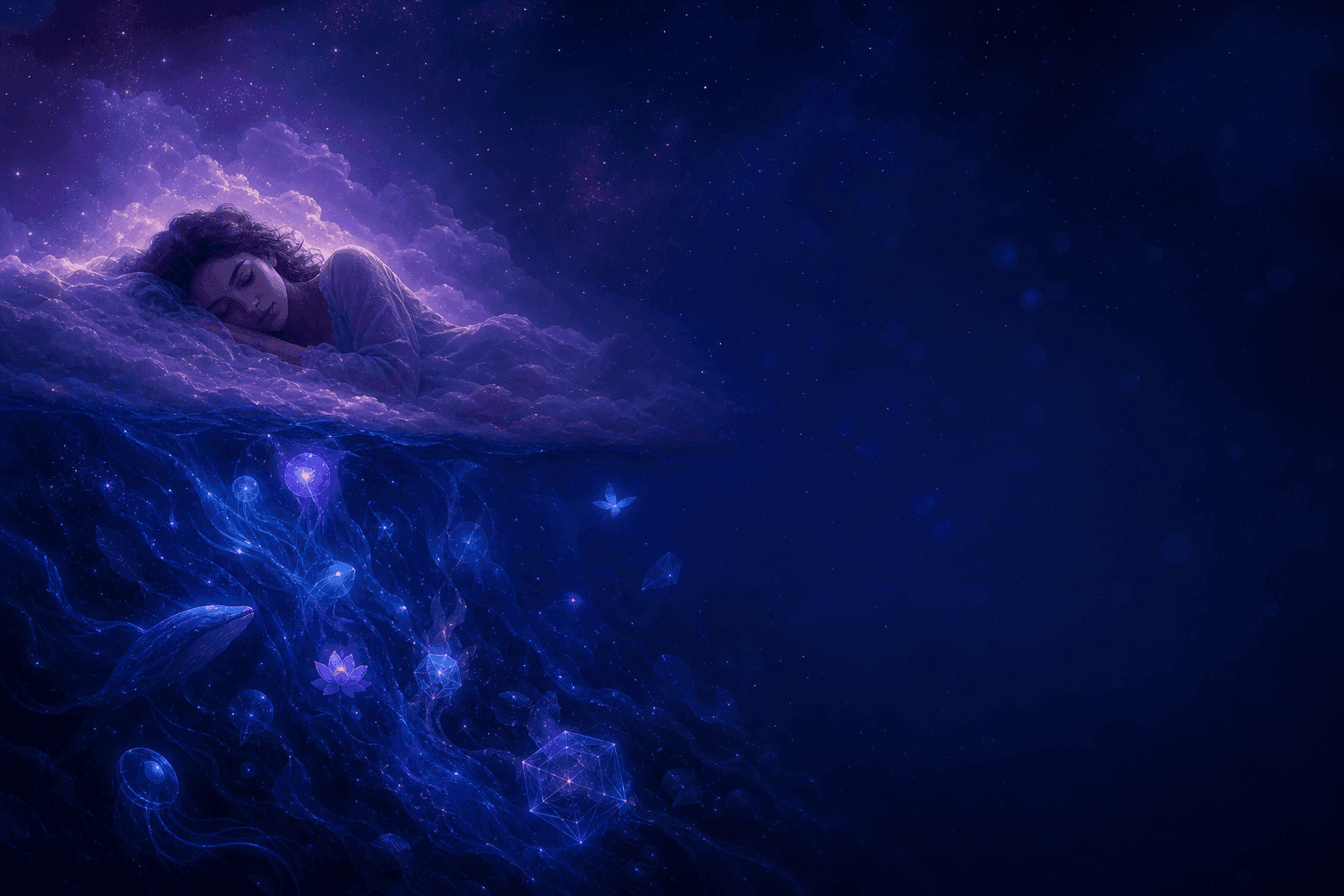
One of modern psychology's strongest theses is that dreams are the "royal road to the unconscious." Operating outside our awareness, this deep layer assembles in dreams what we suppressed during the day, the conflicts we did not resolve, and the cues we did not consciously register. This guide examines what the subconscious is, how it relates to dreams, and how its symbols are decoded.
What Is the Subconscious?
The subconscious is the totality of mental processes we are not directly aware of, yet which constantly shape our thoughts, feelings, and behavior. Our memories, repressed fears, habits, automatic reactions, and most of what we call "intuition" are actually held in the subconscious.
In Sigmund Freud's famous "iceberg" metaphor, our consciousness is the small peak above the water; the subconscious is the massive body below. Carl Jung added that beyond the personal subconscious, a "collective unconscious" is shared by all humanity.
Dreams Speak the Language of the Subconscious
During sleep - especially in REM - the conscious mind's controls relax, and the content of the subconscious surfaces as symbols, images, and scenes. This is why many dreams do not directly summarize "the day"; they instead stage a repressed emotion, an unresolved decision, or a worry we hadn't noticed.
A classic example: an issue you said "I'm fine" about during the day showing up as a snake or as being chased in a dream is the subconscious saying "there is a problem."
Freud: The Interpretation of Dreams
Sigmund Freud, in his 1899 work *The Interpretation of Dreams* (Die Traumdeutung), defined dreams as the language of the unconscious and argued that every dream has two layers: "manifest content" (what you see) and "latent content" (the often repressed desire or conflict beneath).
For Freud, a dream is the surface form taken by these repressed contents after passing through censorship and symbolization. The Sigmund Freud page covers his method in depth.
Jung: Collective Unconscious and Archetypes
Carl Jung, while a student of Freud, broadened this framework. According to him, beyond the personal there is also a "collective unconscious" shared by all humanity, populated by what he called "archetypes": the mother, the shadow, the anima/animus, the wise old man, the hero.
For Jung, dream symbols like water, snake, or a wise elder carry not only personal but collective meaning. The Carl Jung page deepens this view.
Modern Neuroscience and Dreams
Today's neuroscience shows that dreams arise from the interaction of the limbic system (emotion) and hippocampus (memory) which are particularly active during REM. As the brain consolidates the day's information during sleep, emotionally loaded content is converted into symbols and scenes.
This supports Freud and Jung's intuition that dreams speak the subconscious's language while updating the "repressed desire" explanation with "emotional memory processing."
Decoding Subconscious Messages
The subconscious rarely speaks plainly in dreams. Try this:
1. Name the emotion the dream gave you - emotion is read before symbol.
2. Identify the recurring element. Recurring Dreams is a separate guide on this.
3. Open symbols by free association: what does this remind me of in life?
4. Compare both Islamic and psychological interpretations - they complement each other.
Subconscious Defense Mechanisms in Dreams
The subconscious uses certain "defense mechanisms" to mask emotions it cannot accept or process and carries them into dreams. The main ones are displacement (staging another object instead of the real target), symbolization (clothing the emotion in an image), condensation (combining several different fears into a single figure), and reversal (staging the exact opposite of the real feeling).
This is why there is often only an indirect relationship between the "manifest content" we see in a dream and the actual message. Symbols should be decoded through one's own associations rather than the "dictionary meaning," for this very reason.
Practical Examples for Decoding the Subconscious
Recurring chase dream: The subconscious is usually telling you there is a topic you are avoiding facing in waking life. Even if you do not remember who the chasing figure was, the emotion you wake up with (shame, guilt, helplessness) is the real message.
Dreams about an ex: Most often these are not about that person but about a quality they carried (freedom, trust, excitement). The subconscious is signaling the absence of that quality now.
Constantly getting lost: Points to being on the verge of a directional decision in life. Whether the location is familiar shows whether the decision concerns the past or the future. Our Recurring Dreams page details these patterns.
Frequently Asked Questions
Are dreams really messages of the subconscious?
Modern psychology and neuroscience largely agree that a significant portion of dreams reflect emotion and memory processed by the unconscious. Not every dream carries a deep message, however - some are simply reflections of routine daily events.
How do I learn what's in my subconscious?
Keeping a dream journal, opening symbols through free association, and naming the dream's emotion are the most practical methods. For professional support, psychodynamic or Jungian therapy uses dream analysis systematically.
What is the main difference between Freud and Jung?
Freud saw the unconscious mainly as the realm of repressed sexual and aggressive desires, while Jung divided it into personal and collective layers and argued that dream symbols also carry a universal collective dimension.
What does the symbol I see in a dream tell my subconscious?
Before consulting a dictionary, look at your own associations - the same symbol carries different meanings for different people. Our dream interpretations dictionary is a good starting reference.
Related Dream Meanings
Related Sources and Scholars
Related Guides
Interpret Your Dream with AI
Our AI-powered system analyzes your dream using Islamic and psychological sources.
🌙 Free Dream Interpretation